
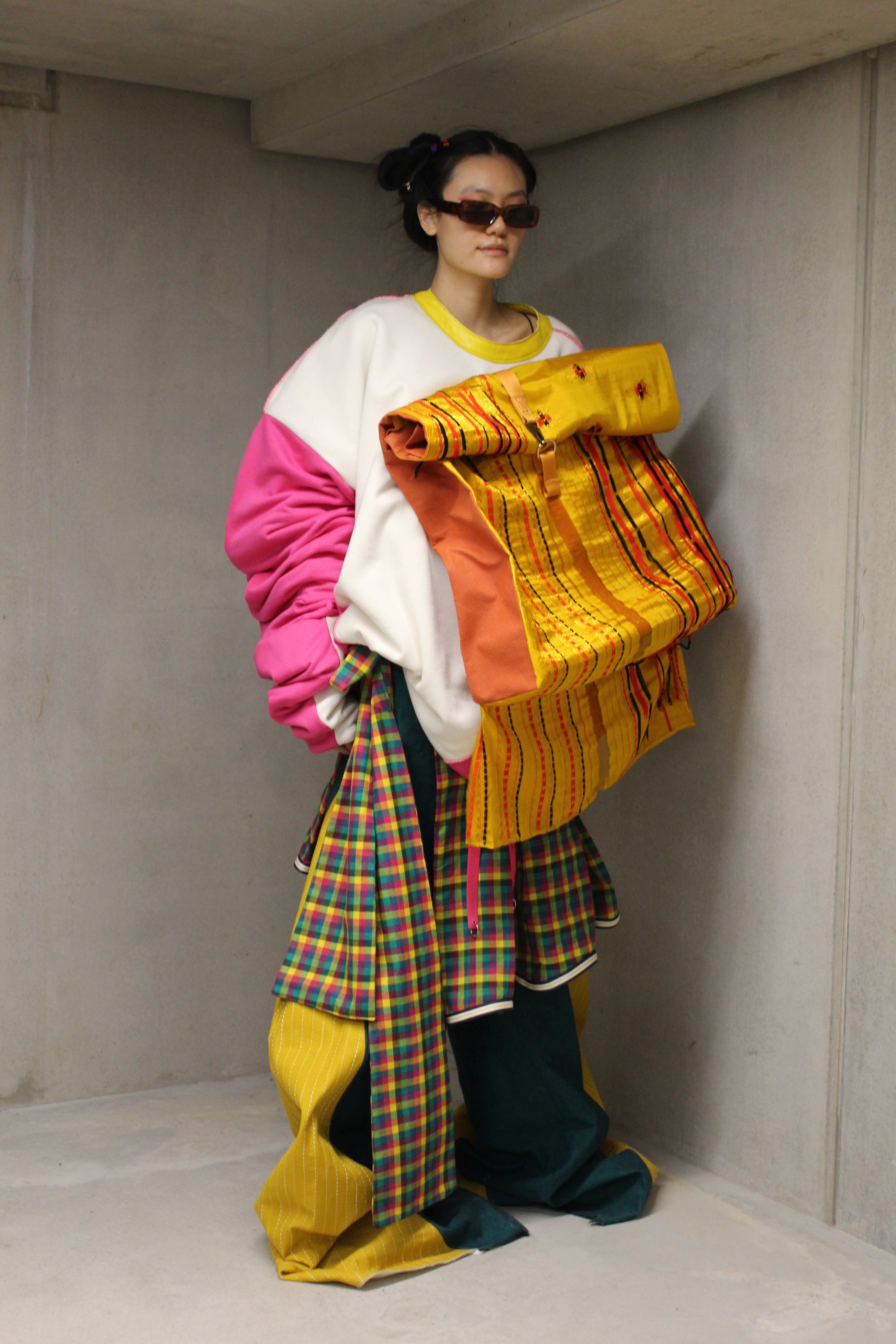
“I want to do something more than an oversized T-shirt and an oversized trouser.”
Streetwear comes with a visual vocabulary. Usually it's always one or the other - oversized silhouettes, familiar proportions, a certain palette. A set of references shaped heavily by Western fashion culture. For Warya, that definition always felt too narrow. A designer from Nagpur, Maharashtra, Aishwarya developed a collection that takes the foundations of streetwear and pushes them somewhere much more personal: into the colour, craft and materiality of the Indian streets she grew up around. The result is not an attempt to make traditional Indian textiles look contemporary by stripping away what makes them recognisable. Instead, she does almost the opposite. Handloom becomes the starting point for clothes that are experimental, maximalist and unmistakably streetwear. “I’m a maximalist,” she says. “I always thought that I want to do something more than an oversized T-shirt and an oversized trouser.” That instinct became the basis for a collection that asks what Indian streetwear could look like when it is not filtered through an already established Western template. The idea did not begin as a neat exercise in combining two contrasting worlds. Aishwarya had always been drawn to streetwear. During her earlier studies, she had also spent time working with craft clusters and weavers, experiences that left her with a lasting desire to build her practice around Indian handicrafts and handloom. The connection between the two emerged gradually. She started with the question of why Indian streetwear so often seemed limited to familiar oversized silhouettes. Then she looked at the environment around her. “What is more vibrant and beautiful than an Indian street, like an actual Indian street?” she asks. “It’s so vibrant, it’s so colourful, it’s so chaotic.” That slowly became a design prompt. Traditional fabrics were brought into the language of streetwear. Familiar archetypes were taken apart, exaggerated and reconstructed. Sometimes the experimentation began with colour rather than textile. Sometimes with fabric rather than silhouette. Sometimes neither combination worked. The collection developed through trial and error until the two influences stopped feeling like separate references and became part of the same design language. The result is clothing that is experimental and colourful, but still deeply connected to the communities that produced its materials.
For Aishwarya, that connection is not symbolic. Most of the fabrics in the collection are handloom and were sourced directly from weavers. She travelled to a small village in Azamgarh near Banaras, where she sourced fabric from a weaver’s family. The material was deadstock. Some fabrics had been sitting unused for years, including pieces originally made by the weaver’s grandfather. For a designer interested in pushing traditional materials into unfamiliar contexts, the deadstock became part of the story rather than simply a constraint. The collection was built entirely from deadstock fabric, while the craftsmanship and provenance of the textile remained visible within the final work. It also reflects the kind of relationship she wants to have with craft. Her interest in handloom goes back to those early experiences of working directly with craft communities. The collection therefore is not simply streetwear with an Indian textile added to it. The making itself is part of the concept. Traditional fabric enters a form that it is not usually associated with. And that collision is precisely the point. The collection was presented by LCF in a showroom space during London Fashion Week and later at York Fashion Week. She also says an editor from Vogue America encountered the work while in the UK and later mentioned her and the collection in Vogue Runway. Those moments mattered. But the bigger challenge was not necessarily getting people to notice the work. It was learning how to operate inside a fashion system she had never worked in before. “When you come from a completely different country, with absolutely no knowledge of the new country, of where to source from, where to go,” she says, “you’re completely in an unknown territory.” For a fashion designer, that unfamiliarity extends far beyond the obvious. Where do you source raw materials? Who can manufacture something locally? Is it more economical to collaborate with someone on footwear or jewellery, or make everything independently? Which suppliers are reliable? Which options are affordable? These are practical questions, but they shape what a designer can actually make.
There is another layer to the equation - currency. For Aishwarya, coming from India into a country with a very different economic context affected what she could afford to source and therefore what she could produce. She describes the difference as significant enough to change the possibilities available to her compared with students from stronger economic backgrounds. The issue is not only that something costs more. It is that the same budget can buy very different levels of quality depending on where you come from. That can become especially visible in fashion education, where everyone may technically be working within the same academic environment while operating with very different financial realities. Yet she also sees an unexpected upside to that period of uncertainty. Because she was working on a master's collection rather than immediately producing at commercial scale, she had room to experiment without worrying about selling hundreds of units or proving that every design could be manufactured efficiently. Like many emerging designers, she had been focused on the work rather than stepping back to assess it. External recognition helped reinforce the idea that what she had created was not simply unfinished work that still needed to become something else. It was already a strong collection. But there is a distinction in her experience between being recognised and reaching the people the clothes are actually for. Much of her current network, she acknowledges, is made up of other creatives rather than consumers who would realistically buy the clothing. That makes it difficult to know exactly how a broader target audience would respond. And for an emerging designer, that gap is important. Because the right audience is not automatically the audience that happens to surround you.

Aishwarya Singh, Founder, Warya


