
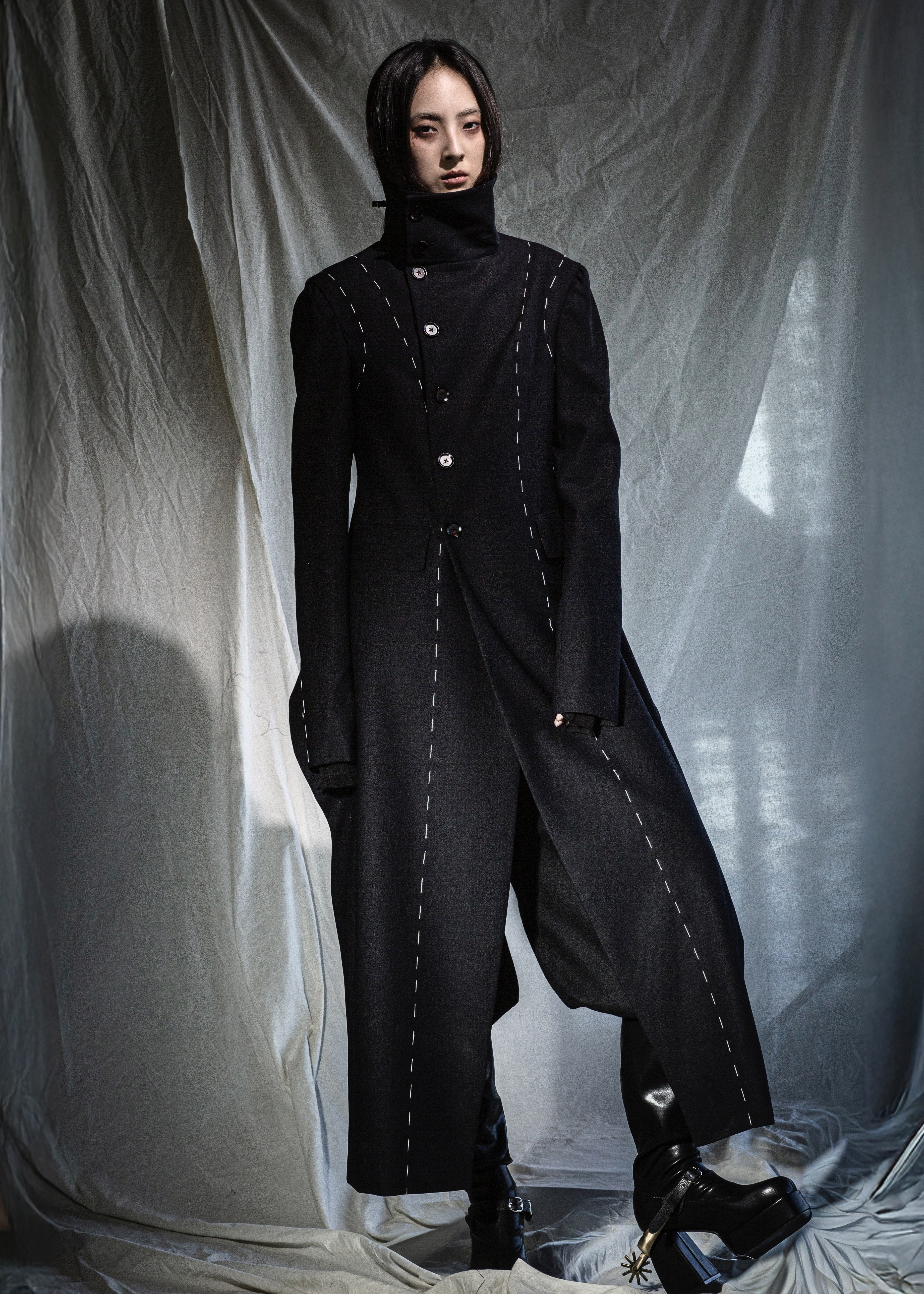
For Stephen Liu, Eastern philosophy is not something to be translated into obvious visual codes. It is embedded in the way a garment falls, moves and is made.
There is a particular kind of fashion that asks to be understood slowly. Stephen Liu’s work belongs to that category. His collections do not rely on spectacle or overt symbolism. Instead, they are built through proportion, movement, exposed construction and a careful tension between softness and structure. The effect is restrained but never anonymous. For Liu, that restraint comes from a lifelong negotiation between cultures. Chinese and Italian by heritage, born in Los Angeles and shaped by time spent in Beijing, Rome and London, he describes his practice as a dialogue between Eastern philosophy and European tailoring. Yet the distinction between the two is less rigid in his work than the phrase might initially suggest. “I have grown up carrying both Eastern and Western cultural perspectives,” he explains. “Rather than treating them as separate identities, my work is about allowing them to exist in conversation with one another.” That conversation happens in the making. Liu draws from the fluidity of East Asian garment construction, particularly Japanese approaches to draping, negative space and the relationship between fabric and body. Against that, he places the discipline of European tailoring: precision pattern cutting, structure and refined construction. One does not simply decorate the other. They continuously negotiate. The result is clothing that appears effortless while revealing an extraordinary amount of thought beneath the surface. That tension between effort and ease runs through Liu’s collections. Lost in Dreamscape explored the space between reality and imagination, using softer, more fluid garments to consider identity and femininity. Rather than designing femininity as an external subject, Liu approached the idea through introspection, imagining how he might express himself through the qualities he associates with an independent woman. The Afterparty moved into a different emotional register. Its starting point was not the event itself but what remains when the event is over: reflection, vulnerability and the moment when performance disappears. That shift also changed the clothes. Liu introduced greater structure while retaining the fluidity that has become central to his practice. Exposed seams, hand-pressed pleats and deconstructed construction were deliberately left visible, turning the mechanics of making into part of the design language. “There’s a sense that beauty doesn't come from perfection, but from honesty,” he says. That idea feels particularly important in a fashion environment that can place enormous value on polish. Liu is interested in the opposite question: what happens when the construction is allowed to remain visible? For him, the narrative of a collection does not need to be printed onto a garment. It should already exist within its silhouette, movement and emotional register. The title simply opens the door.
Liu’s clothes are often described through words such as restraint and precision. Neither is accidental. “I've always believed that one of the most beautiful parts of the creative process is transforming something chaotic into something calm and intentional,” he says. For Liu, restraint does not mean reduction for its own sake. It means editing. A line, seam or proportion should justify its presence. The design process becomes one of distillation, stripping away until only what matters remains. It is a philosophy that can be felt particularly clearly in the garments that look simplest. The Rider Pants, for example, took significantly longer to develop than anticipated. What appears relatively effortless was the result of repeated pattern iterations and draping experiments. Liu describes the process almost as engineering, carefully negotiating the relationship between fabric, gravity and human movement. That is perhaps the clearest way into his work: the clothes are quiet, but the thinking behind them is not. There is another tension at the centre of Liu’s practice, one that extends beyond aesthetics and into cultural perception. He is aware that there can be an expectation for East Asian-rooted designers to make their heritage immediately legible through familiar visual markers: motifs, colours, traditional references or recognisable symbols. Liu rejects that premise. “What interests me,” he says, “is expressing what East Asian influence looks like today.” For him, heritage is not something to reproduce as costume. It exists in the way he thinks about form, balance, craftsmanship and the relationship between fabric and body. It is present in process rather than necessarily in imagery. This distinction matters because cultural influence does not always need to announce itself. Liu’s understanding of Eastern philosophy is rooted in a way of making that listens to the material rather than forcing it into a predetermined outcome. Fabric, he suggests, has its own character. The designer's role is partly to understand it. “I want the fabric to lead the conversation, not simply obey it.” It is a striking proposition, particularly within an industry where control and authorship are often treated as synonymous. Here, authorship comes through responsiveness.
Liu has already received recognition from major fashion publications including Vogue China, British Vogue and GQ China. But visibility, he argues, is not the same thing as access. “Press has certainly given us credibility, but I don't think recognition and access are the same thing.” His experience across China and the UK has made the differences particularly apparent. The ways audiences discover fashion, the ways stories circulate and even the visual language through which a collection is communicated can shift significantly between markets. A headline can open a conversation. It cannot necessarily build the relationship that comes after it. For Liu, some of the most valuable forms of recognition happen away from the page: a buyer introducing the brand to another buyer, a stylist recommending the collection to an editor, or someone sharing the work simply because they believe in it. That distinction feels especially relevant for emerging designers navigating an industry where discovery and access are often treated as if they are interchangeable. They are not. Visibility can create awareness. Trust creates movement.


